Since my last book review in the fall, I have actually read some other books. Here are my reviews of them!
History Decoded: The 10 Greatest Conspiracies of All Time by Brad Meltzer

This book is the basis for the History Channel's series of the same name. It discusses, well, conspiracies. Did John Wilkes Booth actually die in the burning barn in Virginia or live under a pseudonym for years to come? What really happened at Area 51? And, of course, how many conspiracies can you name surrounding the assassination of Kennedy. The book ranks the 10 greatest conspiracies from ten down to one, with Kennedy being number one. Some of the first stories were interesting because I have never heard of them before - like what happened to all of the Confederacy's precious metals after the Civil War and are they still buried somewhere today? However, by the time I got to the last chapter I had lost interest, but read it anyway. I was thinking I could learn some spectacular new theory about who killed JFK and why they did it, but alas, it just listed all the possible theories that any who has ever googled "JFK assassination" would have found.
If you've never really read anything about conspiracies and think that this sounds interesting, it would probably be a good book to try. If you are a history nerd who questions everything you read and assumes everything could potentially be a government cover up, you'll be bored with this one.
Outiliers: The Story of Success by Malcolm Gladwell
David and Goliath: Underdogs, Misfits, and the Art of Battling Giants by Malcolm Gladwell
Malcolm Gladwell is a numbers guy from Canada. He is so into numbers that he was invited to speak at the National Council of Teachers of Mathematics (NCTM) annual meeting in Salt Lake City several years ago. I remember listening to him speak and thinking that what he had to say was very interesting, but then I couldn't keep track of the purpose or message behind his thoughts. That's kind of where I was reading these books.

I really liked the beginning of both of them, but then I just couldn't finish them. I probably should have skipped to the end to see how he wrapped it all up, but they both expired and disappeared off my phone before I was able to do that.
 Outliers
 is a statistical term for things that are out of the ordinary, don't fit within the regular data set, and are so far out there that if you consider them, they can really throw off the mean. Gladwell looks at people who are outliers and how they got to be where they are. He begins by talking about professional hockey players in Canada and how we may think they were all born with this innate ability to play hockey, but when you look at the data behind it, you find that most of them have birthdays between January and March. Why? Canada's youth hockey leagues are grouped by year of birth. The kids with January birthdays are likely to be bigger, faster, and stronger than the kids they are playing against who have December birthdays. The kids who are selected to go on to the next levels and then given more opportunities for better coaching and more hours of experience are picked out from those who have "natural" talent. However, the "natural" talent of the unskilled is usually the kids who are simply older. If you have a later birthday, you simply aren't likely to be a professional hockey player in Canada. The same is true for soccer in most South American and European countries.
Gladwell goes on to discuss the success stories of Bill Gates and The Beatles. The Beatles were a result of 10,000+ hours of practice, mostly during trips to Germany to get them where they were. Bill Gates was a result of circumstance and opportunities presented to him at a young age that would not have been in the sights of many of his peers. The book tends to debunk the notion of rags to riches stories and pulling yourself up by your bootstraps, but rather circumstance, opportunity (for sure being able to have the work ethic to grasp at the opportunity), and literally being in the right place at the right time.
David and Goliath has a similar tone. David didn't biblically defeat Goliath just simply because God willed him to do it (don't read too much into the spiritual nature of this), but because he attacked Goliath's weaknesses. Basically, he wasn't fighting Goliath the way that Goliath had been trained to fight. He used skills and tools that totally caught Goliath off guard and usurped the traditional style of the fight. Anyone can be defeated if you use the right tools and attack in the right places, usually using methods that the enemy wouldn't be likely to use.
Gladwell discusses a silicon valley computer nerd who coached a youth girls basketball team. The girls were terrible and the coach had no sense of the game either, but decided that he could win if the girls on his team were able to get the ball under their basket and score quickly. His strategy was to play a full-court press for the entire game. He ran the girls like crazy so they were well-conditioned and then taught them a few defensive moves and how to trap the ball. The girls flustered even the best of teams because they were able to stop the ball before it crossed the timeline and get quick steals and layups. They attacked the weaknesses of their opponents by catching them off guard and playing by non-traditional methods. The basketball nerd in me says 1) don't press if you don't have to because you're messing with the game and 2) can you really press an entire game and not just die of exhaustion. Anyway, it was something to think about.
There are other stories that are interesting like this one, and I enjoyed the first few chapters, but then again, I lost interest. I would recommend taking a look at these if you like the statistics and analysis behind real-life situations.
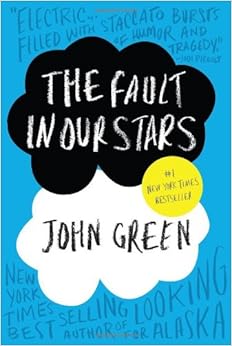
The Fault In Our Stars by John Green

I guess this book is considered juvenile literature, so perhaps it is because of my closeness to juveniles that I liked it. Honestly, I was quite smitten by the book! It's fiction, which is a genre I really don't read much. The last fiction book that I actually made it all the way through was
The Help (which I also quite liked).
The synopsis of the book is that the high-school aged Hazel Grace has terminal cancer but has had good luck with a new drug that seems to be extending her life. Her parents make her attend support group where she has a friend Isaac and then meets her love of the book, Augustus "Gus" Waters. Gus has cancer that caused him to lose a leg, but is currently in remission. Isaac, by the way, has eye cancer, already has one glass eye, and is going to have surgery to remove the other.
Though the premise seems super depressing, full of cancer, ICU visits, etc., the book is full of fun, quirky, witty conversations between Hazel and Gus. Gus is heroic and silly and very likable. The book is full of quotes that will end up inside the lockers of high school girls like, "
I fell in love the way you fall asleep: slowly, and then all at once." I like the book because even though they are high school aged students, they are very smart and mature (perhaps caused by dying from cancer), but also just goofy high school kids trying to figure out their place in the world around them while interacting with each other, their parents, doctors, and peers. The book is very well-written and it is easy to become completely engulfed in it. Plus, it is short. I actually read it twice.
Without giving too much away, please note that people with terminal cancer eventually die so the end of the book may require some klenex.
I was a little late to the Fault bandwagon and the movie has been out a while, but my friend Emily and I went to see it a couple of Saturdays ago. The movie was pretty good, too, and I liked the soundtrack. I would advise that you read the book before you see the movie. Here is the trailer (sorry there isn't a movie about the Malcolm Gladwell books, as if anyone really wants to see them).